The Pot Maker
06 July 2026WORDS BYTemsula Ao
Originally published in Temsula Ao: These Hills Called Home: Stories from A War Zone (Zubaan 2007). Reprinted here courtesy of the publishers and the author's family.
Ever since she became old enough to accompany her mother to the fields and forests, she began to dream of becoming a pot maker like her mother and grandmother. Her mother tried to make her learn weaving, a skill highly valued as an asset in any girl Lut she only wanted to make pots, and lots of them of various sizes and shapes. On days when she managed to stay at home while her parents and other elders went to the fields, she sought out the women who were expert potters and asked to be taught the skill. They were at first amused by the little girl’s insistence; they thought that she would soon outgrow her childish passion for the craft. They told her that it was back-breaking and often frustrating work, especially when a sudden shower ruined weeks of labour, and the pots drying in the sun were destroyed by the rain. Some batches might be completely ruined if the firing in the makeshift kiln was not done properly. Out of a hundred pots, they told her, only fifty or so would turn out well enough to fetch a good price, The rest would either have to be used at home for various purposes or given away. They asked her, had she not heard her mother or grandmother ever complain of these difficulties? She said yes, but she wanted to be a better pot maker than anyone in the village and when she made pots, she told them, she would sell every single one of them. The earthen pots made in this village were famous all over the region and people from far off villages, and even from other tribes, came to either buy or barter the pots with produce from their fields. The little girl had seen her mother exchange pots for chillies, dried fish, and a wooden stool and at one time even a dao for her father in exchange for the biggest pot that she had made.
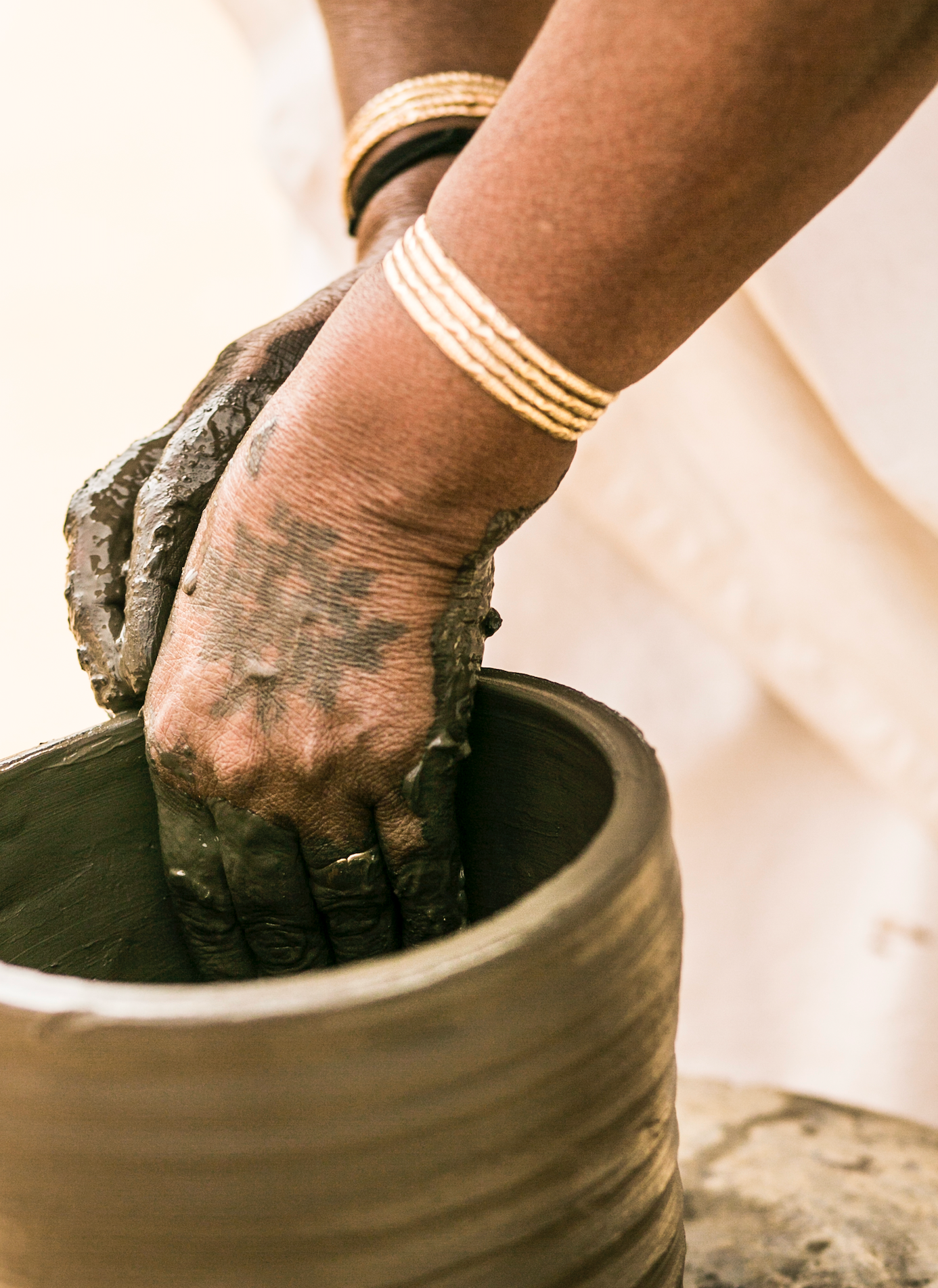
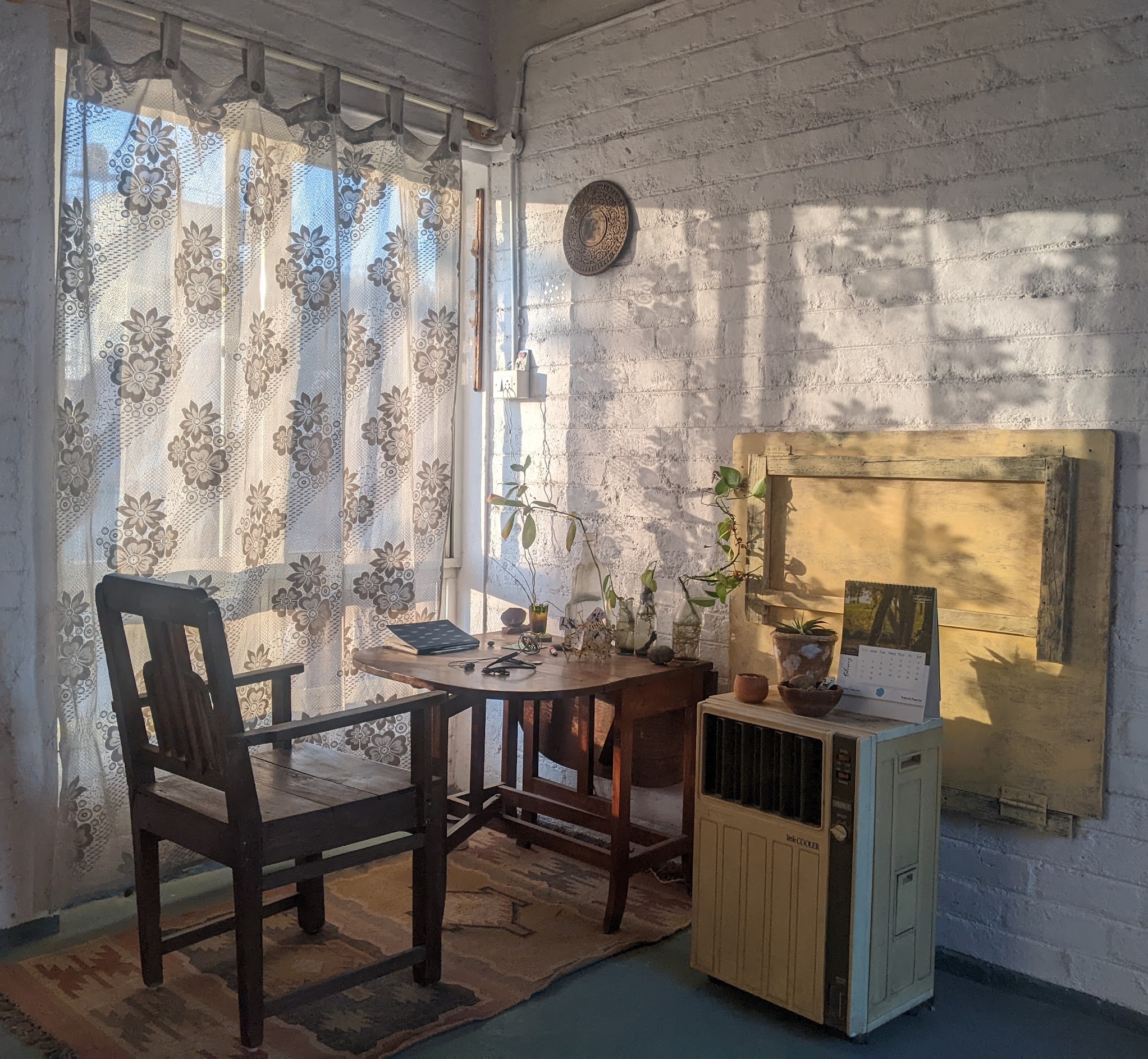
Photograph: Ramya Reddy, Soul of the Nilgiris
The reason why the little girl did not disclose her fascination with pot making at home was a conversation between her parents one night that she had overheard. The mother was complaining to the father about their daughter’s indifference to weaving. She said, ‘I don’t know what will happen to our daughter when she grows up, she seems so reluctant to learn the craft, she won’t even pass the yarn bowl properly when 1 am at the loom. She will grow up to be a useless girl and no man will want to marry her.’ The father kept quiet, while the mother went on in this vein for quite some time. Eventually, he answered, ‘She can learn pottery from you or your mother can’t she?’ ‘Never’, the mother’s voice rang out, ‘I shall not teach her this craft which has brought no joy to me and only a pittance for my troubles. Do you know how far that wretched place is from the village? Sixteen kilometres and a sheer drop to the riverbank; still we have to climb down because it is only there that you get both the grey and red clay required for making pots. You do not know how difficult it is to dig the clay from the hillside because you have never come there to help me saying that no man can be seen meddling in anything to do with pot making. It is woman’s work. I cannot even begin to tell you how your back aches from carrying the heavy load uphill all the way to the village, and then pounding the stubborn clay inside bamboo cylinders to soften it. You have not felt how your left hand goes numb from holding it inside the moist clay while the right one wielding the spatula screams in pain with every tap on the clay. Do you know how many times I’ve dropped the mould out of sheer exhaustion and have had to start all over again to make one single measly pot? It takes months to bring out a batch after so much labour. And the reward? A few rupees. But if she learns weaving, she can make much more money besides providing enough cloth for the family. No, I shall not condemn her to a fate such as mine.’ When the husband reminded her that they too need pots for their own use, she countered, ‘Do you know how many pots we can get in exchange for a single shawl? Five, if they are big and six, if small. How many pots do you think we need, only three or four, which will last us for at least a few years.’ Anticipating another rejoinder from her husband, she quickly added, ‘Yes, I do admit that even weaving demands a lot of hard labour; your back aches and your eyes get strained. But you need not climb any hill and be out of doors in all kinds of weather. Weaving is not messy like pot making and can be done indoors in all seasons. Also the time spent on weaving one shawl is much less and the return is handsome. So be warned, our daughter shall not learn this thankless craft from me during my lifetime. I shall not pass on this burden to her.’
So the little girl, whose name was Sentila, started going to these old women in another part of the village to watch them at work. To see how the clay was mixed with water and pounded, how careful they were when they pushed their left hand into a lump of the softened clay and how deftly they rotated the lump as they started giving shape to the rotating clay with a spatula held in the right hand. The regular tap, tap of the spatula on the clay was music to her ears as she watched in fascination the pot emerge out of a shapeless lump of clay right in front of her eyes. When the pot maker was satisfied with the shape, she would gently lower the newly made pot on to a spot in her work-place and pull her hand out of the narrow mouth of the pot carefully so as not to distort it because the clay was still soft. It would take time to become firm enough to retain its shape. After two or three days, again the pots would be given a final touch up in order to retain the required shape and to test the consistency of the still moist clay. Only then would the pots be taken out to dry in the sun. After that they would be loaded on to a kiln in a uniform pattern on a bed of hay and dried bamboo and covered with another layer of the same materials, and then the kiln would be fired. The required temperature had to be maintained throughout the firing process. Therefore one had to tend the fire carefully; over firing or under firing would ruin the entire batch.
As it happens in any small community where everyone knows everyone else, the little girl’s obsession with pottery became known and soon the mother came to hear of her daughter’s visits to these pot makers. She did not say anything to the girl at first; she decided to wait and see how serious the girl was about this. She pretended that she did not know where she went on the days that she was left in the village to look after her younger brother. When Sentila visited the old women, the baby, who was ten months old, would be strapped to her back with a cloth and she would labour up the steep hill to reach their work shed. She would carry some cooked rice in a leaf packet with her on these trips. When the baby brother became hungry, she would chew some of it and, once it was soft, she would feed it to the baby. Then she would sing a lullaby to put him to sleep while she watched the women work intently. One of the old women sang beautiful folk songs while working but when something went wrong, she would substitute the words of the songs to suit her anger and frustration, which made everyone laugh. Sentila enjoyed being there but by late afternoon she had to leave them. So she would gently pick up her brother from where he slept, and deftly swing him on to her back, would walk home quickly so that when her mother reached home from the fields, she would be there.
Sentila’s regular visits to the old pot makers’ shed became a topic of village gossip. People started asking why she had to go to these other women to learn pot making when her own mother and grandmother were renowned pot makers themselves. Why was the mother, called Arenla, refusing to teach her daughter the skill, which was her birthright? If all pot makers followed suit, then there would be no expert potters to take their place and the village would lose its status as the only village whose pots were coveted by all. Didn’t Arenla know that in the days of head-hunting, this village was spared many times because of their skilled pot makers? As days went by, the gossip became open debate and finally one day, Sentila’s father, whose name was Mesoba, was summoned by the village council and asked to explain what was happening in his household, why his daughter was making these regular trips to the old pot makers’ shed to learn the craft and most important of all, why was Arenla refusing to pass on the skill to her daughter. Mesoba was caught in a dangerous situation; if he told them what his wife had said about pot making and why she wanted their daughter to learn another craft like weaving, they would find fault with her and an immediate fine would be imposed on her for going against ‘tradition’. On the other hand, if he pretended to know nothing about his daughter’s clandestine activity, they would not believe him and he would be ridiculed as an incompetent husband and father and not only that, he too would be fined. He pondered over their query for a while and replied in a humble tone, ‘Uncles and elder brothers, I admit that we have all along known about Sentila’s visits to the old ladies and why she loves going there. She told us that a particular lady sings beautiful lullabies and gives her sweet potatoes every time she sings with her. Her mother has never said that she will not teach her pot making; it is only that we wanted her to grow a little bigger and stronger after her illness before we took her to Lithu (the river-bank) to dig the clay. In fact, I have ordered a small digging dao for Sentila at the blacksmith’s just yesterday. So what has been circulated by idle mouths is not really true. You will soon see that Sentila will start making the best pots in the village.’ What Mesoba blurted out to the elders was impromptu; it was a desperate attempt to avert their ire. But luckily for him, what he said did have a ring of truth; there indeed was a noted folksinger among the old pot makers who sang while she worked and who gave a sweet potato to the little girl one day. Sentila had indeed fallen sick just recently and he had indeed placed an order for a small dao meant, not for Sentila of course, but for his wife to use in the kitchen garden. After listening to Mesoba’s explanation, the elders decided that there was no cause to take any drastic action against him yet and so they let him go, cautioning him to remind his wife that it was her duty to teach her daughter the skill that was handed down from generation to generation for the good of the entire village. They also told him that skills such as pot making, which not only catered to the needs of the people but also symbolised the tradition and history of the people did not ‘belong’ to any individual. And experts were obliged to pass on their skills not only to their own children but also to anyone who wished to learn. ‘Think of the teaching that goes on in the morungs, the dormitories for young men which is our way of educating our youngsters in the requisite skills for survival. In the same way mothers are to educate their daughters in the skills meant for women. Your wife should be willing to pass on the gift to her daughter.’ And ominously they added, ‘Anyone refusing to do so will be considered an enemy of the village.’
That evening, Mesoba went home with a heavy heart because of the rude reminder of how things were with them in the tightly knit community of the village. His wife’s arguments did make practical sense but he could not ignore the logic of the village council, which always put the collective good above individual interests. And if he wished to continue living peacefully in that community, he, or rather Arenla, had to set her personal objections aside and do what was expected of her. They chatted late into the night and decided that from now on, Sentila would no longer be left in the village to baby-sit her brother but would accompany them to the fields.
In the following year, Sentila was taken by her mother to Lithu where the grey and red clay was available. She was taught how to dig the clay with her implement, how to load it on to her carrying basket and how to soak it in the trough in the work shed before stuffing it into the bamboo cylinder in the right proportion and how to pound it. She was a quick learner and she did not mind working hard to achieve the right consistency and colour in the clay to form a sort of malleable dough. But when she tried her hand at the actual shaping of the lump into a pot, she came up against a lot of difficulties. She could not hold the lump of dough on her thigh properly; her moistened hand kept slipping as she tried to plunge it inside to hold it firm before the spatula in the right hand could start tapping the dough into the shape of a pot. The first attempts were disastrous and Sentila cried her heart out at her incompetence. But she persisted and would not admit defeat. The mother simply sat in a corner and watched the girl try again and again to transform the clay into a pot. Even if Sentila was doing something wrong in the process, her mother kept her counsel. Sentila would send appealing looks towards her mother who remained unmoved. The whole process seemed to have become a contest where the mother’s will seemed to thwart every attempt of the despairing daughter to create even the semblance of a pot out of the recalcitrant clay. While Sentila hung her head in shame and frustration, the mother would push her daughter from the low stool and take over the job, wielding the spatula expertly over the clay held firmly on her thigh and gloat when the lump was transformed into a beautiful pot. ‘Do you think that you can ever make anything like this?’ she would spitefully ask her distraught daughter. These sessions continued for almost a year but throughout this period, the daughter was made to feel so inadequate before not only the mother’s expertise but also her open disdain, that she was unable to learn anything from her. It appeared to Sentila that her mother’s antipathy to her learning the art was putting a jinx on every lump of clay that she touched. Instead of her dream pots, she could produce only misshapen parodies.
The next year Sentila attained puberty and was required, according to custom, to spend the nights in one of the girls’ dormitories. This particular dormitory was supervised by a kind, middle-aged widow. Like everyone else in the village, she too had heard of the discord in Sentila’s family concerning her attempts at pot making. Also, the latest situation between the mother and daughter had become public knowledge. The older woman took to this serious young girl immediately and resolved to help her in every possible way so that the girl could fulfill her dream of becoming a good pot maker. She began to look for an opportunity to be alone with Sentila so that they could talk freely. But, in a dormitory housing almost twenty girls every night, this was not easy to do. However, an opportunity soon presented itself. One evening it was announced that a renowned singer was coming with his choir to sing for the entire village in the village common. Learning that the lead singer was a handsome man with many other young men in his group, every girl from the dormitory eagerly sought permission from ‘Onula’ or Aunty to go and listen to them sing. Only Sentila said that she would stay back because she was not feeling well. Actually she had been looking for an opportunity to practice her art alone and had smuggled some clay from her mother’s work shed for this purpose. It was as if heaven had manipulated events to allow these two women to come together for a pre-ordained purpose.
After all the girls had left, Sentila quietly took out the clay and the implements from her basket and sat down in a darkened corner to try once again to make a pot. At first she wielded the spatula tentatively, for fear of waking ‘Onula’ who she thought was asleep in her room at the rear of the dormitory. On the contrary, the older woman was watching the young girl’s clumsy efforts with sympathy. She decided to wait for some time before intervening. She noticed that Sentila was too tense, the left hand held inside the damp clay was too stiff and the right hand was not moving fast enough with the spatula on the outside of the lump. As a result, the rhythm between the two was all wrong and the clay seemed unable or unwilling to yield the right shape. When Sentila wearily let the misshapen lump fall flat on the ground, the older woman came out of her room and gently asked the frightened girl what she was doing with the clay. She said nothing but bending her head she began to cry silently. Onula went to her, and putting her arms around her said, ‘Don’t worry, little one, I shall teach you how to make a perfect pot. Come, watch how I sit on the stool, holding my thigh muscles taut and make sure to use sacking to cover the thigh so that the lump does not slip. When you dip your hand in water before slipping it into the clay, make sure it is not too wet. Hold the spatula toward your body and tap gently like this. But most important of all, make sure that the tapping is in rhythm with your left hand rotating inside the clay.’ Sentila watched in amazement as Onula fashioned a beautiful pot right in front of her eyes and asked her to try again. She took another lump of clay and with a confidence she had never felt before, she started the process all over again following the instructions she had just received from the sympathetic woman. As she rotated the lump in her left hand and began tapping on the clay as instructed, she felt exhilarated beyond words. She was creating a beautiful pot! When it was done, she sat there admiring her work. But she was soon jolted out of her euphoria when Onula said, ‘The mouth of the pot is all wrong.’ Sentila looked and saw that indeed where there should have been a gradual tapering of the mould to form a neck-like opening, her pot ended in a wide chasm. She looked at Onula in frustration who only smiled and said, ‘Enough for the evening. The others will soon be back and we must not let anyone know what we have been doing here tonight. When you work with your mother next time, watch her carefully when she is shaping the mouth of the pot. You are a quick learner and you will do well, but do not bring this work here anymore. It is not from me that you should receive this knowledge. It is your mother who has to pass it on to you. Remember, the village has ruled.’
Sentila looked at Onula in a puzzled way but without saying anything, collected her tools and the pot that she had made that night and hid them in her basket. The next morning, before anyone else was awake she hoisted the basket on to her head and started for home. But before reaching the house, she veered off into the path leading to the village well and hid her pot in a clump of bushes growing nearby.
During the next pot making session, she observed how her mother held the left hand and the spatula, how she slackened the rhythm when fashioning the mouth of the pots and how a strip of elongated dough was added to the mouth to make the rim. She also noticed that her mother was giving her quizzical looks when she caught her paying so much attention to detail. Then, on a bright sunny day, the mother told Sentila that they should try to make as many pots as they could, otherwise they would not have enough days of sunshine to dry them. So they went to the shed quite early and began the process. As usual, the mother completed a batch quickly and asked Sentila to take over. Complaining that she had a headache and that her back was hurting, she went out to the shed after telling the daughter to try and make as many pots as she could. Sentila was surprised at her mother’s assumption that she could make any decent pot at all and found it odd that her mother did not stay back to gloat over yet another debacle. With these confused feelings, she reluctantly slid on to the wooden stool and taking a lump of the clay dough, positioned it firmly on her sack-covered thigh. She dipped her left hand in water and carefully inserted it into the clay. Thus positioned, she took hold of the spatula and lifted it to start beating the dough to give it the required shape. As she lifted the implement for the first tap, she felt as if another pair of hands took over and was directing her movements. As though in a trance, she began to beat the dough in perfect co-ordination with her rotating left hand. The clay seemed to transform itself into another shape and before long she realized that the pot was ready. She sat there transfixed at her own creation, wondering at the dexterity with which her hands had moved as if in unison with her quickening heartbeat. The moment was almost epiphanic. She, Sentila who had suffered so much humiliation in her mother’s presence for failing to master a simple craft, had now created a miracle. After a while she gently lowered the pot and started giving the finishing touches to the neck. When it was completed, she set it aside, separate from the ones her mother had made. She started on the next one, and like a sprinter who had suddenly found his momentum, she continued making pot after pot with the same speed and dexterity that she had noticed in her mother’s hands. Finally, when she looked at her row of pots, she saw that she had made just one short of her mother’s tally.
She realized that it was almost mid-day, and being exhausted from the labour she continued to sit on the stool and wait for her mother’s return. She sat there for a long time, past the hour of the mid-day meal. She was beginning to feel very hungry, so she decided to go into the house and ask her mother to eat with her so that she would get an opportunity to tell her about what had happened earlier in the day. But when she reached the threshold of the outer room where, as in every house, the firewood was stacked and where rice was husked and where the chickens slept at night, a terrible scene awaited her. She found her mother slumped over the low barrier separating this room from the main one as if she was still trying to cross over. Her mother’s supeti (lungi) had come unstuck in the fall and a white thigh was visible even from the street door. Sentila quickly ran forward and carefully retied the supeti to hide her mother’s nakedness; only after that she bent low near her mother’s mouth to see whether she was breathing. She was not. Instead there was a dried streak where the saliva had dripped. Her mouth was agape as if she was trying to call out. Straightening up, Sentila ran towards the village common where she knew that the day’s sentries would be seated around a fire smoking and drinking black tea. When they heard her news, they all raced to the house, carried the inert body inside and laid it on the pallet beside the fireplace. One of the sentries was hurriedly dispatched to carry the news to Mesoba and to summon all the relatives from their fields. Sentila crouched in a corner, dry-eyed and speechless. Throughout the wake that night she was seated by her mother’s body, muttering to herself. She stayed like that all night, refusing food or drink and not going out even once to obey nature’s call. When the body was being carried out of the house the next morning, she ran after it shouting, ‘Mother, I did not wish it to happen this way; it simply came to me. Please forgive me.’ Those who heard her speak, did not understand what she meant, they simply thought that she was so distraught with grief that she did not know what she was saying. But there was one among the mourners who understood: Onula. Though she did not know exactly what had happened the day before, she intuitively sensed that something momentous had transformed both mother and daughter at life’s appointed hour on that fateful day.
On her way back to her own house, she noticed that the door to the work shed was slightly ajar. Out of curiosity, she stepped inside and abruptly stopped in her tracks; two neat rows of newly-made pots stood side by side. Moving closer, she tried to distinguish one batch from the other to determine if it was the handiwork of just one or if a second pair of hands rotated the clay dough and swayed the spatula to create the two separate batches. She could find nothing to tell one batch from the other. She tried hard to reconstruct what might have happened; it could not be the mother’s work alone because Sentila said that she went back to the house much before the mid-day hour, and it could not be Sentila’s work alone because she was too young and inexperienced yet to accomplish so much even in two days. But if both mother and daughter were involved in turning out these pots, was it possible to differentiate between the two batches? Onula stood there for a long time as if trying to absorb a new phenomenon. When she came out of the shed, she had a dazed look on her face and seemed to falter in her gait. Slowly she walked away from this place of wonder, as she considered it to be, because she believed that she had just witnessed a profound revelation in the two batches of still moist pots, standing side by side in perfect symmetry inside the shed.
A new pot maker was born.


You may also like

Read•Issue 10
The Many Homes of Streeties
BY Sindhoor Pangal, Ahana Rangachari, Surabhi Venkatesh, Juhi Patel, Sowjanya S
Pause•Issue 10
Eyrie
BY Suprabha Seshan
Read•Issue 10
The Shape of an Irula Home
BY Jeyanthi R

Pause•Issue 10
Carrying Homes Within You
BY Radhika Iyengar
Pause•Issue 10
A Conversation Between a House and a Ghost
BY Pankaj Singh

Imbibe•Issue 10
Infinite Hearth
BY Nishi Chawla

Imbibe•Issue 10
Home Beyond the Door
BY Jennifer Nandi
Imbibe•Issue 10
Of Letter Boxes, Boxes and Forest Homes
BY K Srilata